
When people talk about water quality in the Pacific Northwest, the conversation usually centers on purity. And Portland genuinely has something to brag about. The Bull Run Watershed, located 26 miles east of downtown Portland in the Mount Hood National Forest, supplies drinking water to nearly one million people across Portland and surrounding communities. It’s protected forest water, naturally filtered through volcanic rock, and it consistently ranks among the cleanest municipal supplies in the United States.

What the accolades don’t mention is the chemistry. Bull Run water is extraordinarily soft. And softness, at the extreme end of the scale, creates a set of plumbing problems that are slow-moving, largely invisible, and genuinely expensive when they finally surface.
Understanding what’s in your water, and what it’s doing to the pipes and fixtures in your home, is one of the more underrated aspects of home maintenance in this region. The answer looks different depending on whether you’re in Portland proper, in the suburban counties served by surface water from the Clackamas River, or out in rural areas drawing from private wells.
What “Soft Water” Actually Means
Water hardness is a measure of dissolved mineral content primarily calcium and magnesium ions that water picks up as it moves through soil and rock. Hard water carries a lot of these minerals. Soft water carries very few.
Bull Run water typically has a total hardness of just 3–8 parts per million — roughly a quarter to half a grain of hardness per gallon. For context, water is generally considered soft below 60 ppm and hard above 120 ppm. Bull Run water sits near the bottom of the scale, and has for as long as records have been kept. This is a function of geology: the watershed is volcanic, and rainwater moving quickly through that environment doesn’t have time to dissolve significant mineral content before it’s collected.
Across the broader state of Oregon, hardness levels vary considerably. Cities like Beaverton and Portland register as low as 2–3 ppm, while places like Newberg, Woodburn, and Keizer see levels approaching 107 ppm — an entirely different category of water chemistry operating just an hour’s drive away.
That contrast matters because soft water and hard water don’t just behave differently at the tap. They interact with your plumbing in opposite ways, and the problems they create require different solutions.
The Corrosion Problem: What Soft Water Does to Metal Pipes
This is the part that surprises most Portland homeowners. Soft water sounds gentle — and in some ways it is. It doesn’t leave the chalky white scale on showerheads and faucets that hard water does. It’s easier on soap, kinder to laundry, and generally more pleasant to bathe in.
But the absence of minerals is precisely the problem for your pipes.
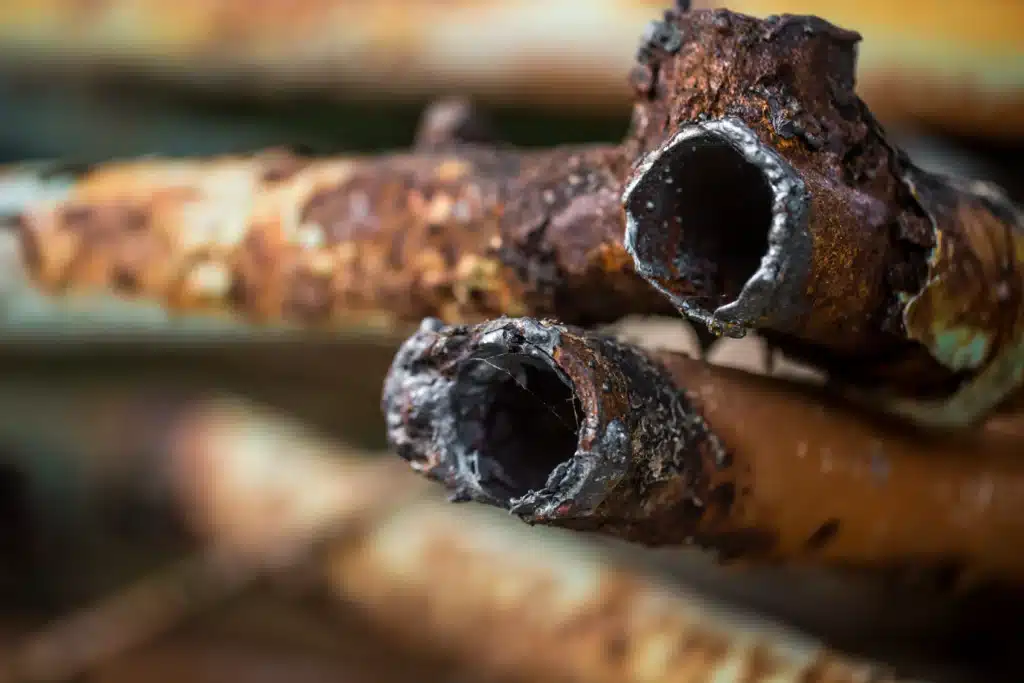
Soft water lacks the calcium and magnesium that allows it to dissolve more carbon dioxide from the air, forming carbonic acid that can corrode metal pipes over time. While it stops the scaling issues associated with hard water, it holds corrosive properties that accelerate deterioration in galvanized and copper pipes, leading to pinhole leaks and structural weakening over time.
Think of it this way: hard water tends to coat the interior walls of metal pipes with a thin mineral layer. That layer isn’t always desirable — in excess it causes blockages — but in modest amounts it acts as a buffer between the water and the pipe wall. Soft water has no such buffer. It arrives at your pipes chemically hungry, ready to dissolve whatever metals it encounters. Over years and decades, it thins copper walls from the inside, weakens galvanized steel, and works its way toward fittings and solder joints.
Low pH water is corrosive and will eat away plumbing and fixtures — and if left untreated long enough, will make the walls of pipes so thin they puncture under the pressure of the water inside. The Bull Run watershed is specifically cited as an example of a water source affected by this kind of acidity.
The failure mode this produces is the pinhole leak — a small, slow breach in a copper line that often goes undetected for weeks or months. By the time a homeowner notices discoloration, dampness in a wall cavity, or a spike in their water bill, the surrounding materials have frequently already sustained mold or rot damage. In older Portland homes where original copper supply lines are still in service, this is not a hypothetical risk. It’s a documented pattern.
Portland’s Response: Corrosion Control Treatment
The Portland Water Bureau has been aware of this issue for decades, and has taken significant steps to address it — though the problem isn’t fully solved at the tap level.
Sodium carbonate and carbon dioxide are added to Bull Run water to increase its pH and alkalinity, which reduces its tendency to leach metals from distribution infrastructure and home plumbing. An improved corrosion control treatment facility was completed and brought online in April 2022, specifically designed to adjust water chemistry and further reduce potential lead levels at the tap. A new Bull Run filtration facility is scheduled for completion in 2027, which will remove Cryptosporidium and other potential contaminants while further refining water chemistry and corrosion control.
These are meaningful public health investments, and they have measurably improved the water reaching Portland homes. The pH of Portland’s tap water now typically ranges between 8.0 and 9.0 after treatment — a significant adjustment from the naturally acidic baseline of untreated Bull Run water.
The important caveat is that municipal corrosion control protects the distribution system — the mains running under streets — and reduces the leaching potential of water before it enters your home. It does not repair or protect the older pipes already inside your walls. A house built in 1955 with original copper supply lines has been exposed to decades of corrosive water before today’s treatment protocols existed. The pipes in that home carry the cumulative effects of that history regardless of what’s been done upstream.
The Other Side of the Region: Hard Water and Scale
Step outside Portland’s service area and the water chemistry problem inverts.
Clackamas River Water, serving portions of Clackamas County, Milwaukie, Happy Valley, Oregon City, and unincorporated areas, delivers water that averages 15 ppm in winter and nearly 29 ppm in summer — softer than national averages but noticeably harder than Bull Run, and variable with the seasons. Communities drawing from the Tualatin Valley system, the Hillsboro municipal supply, or surface water sources fed by lower-elevation watersheds tend to see progressively harder water as you move away from the Cascades.
In harder-water zones, the pipe corrosion threat recedes — but a different problem takes its place. Calcium and magnesium deposits accumulate on every surface water contacts over time: the inside of water heater tanks, the coils of tankless systems, the small orifices in faucet aerators and showerheads, the inlet valves on dishwashers and washing machines. Scale is an insulator. As it builds up inside a water heater, the heating element has to work harder to transfer heat through the mineral layer to the water. Energy consumption climbs. Recovery times slow. The tank itself begins to degrade from the inside out.
A water heater in a hard-water area that isn’t periodically flushed and descaled will typically fail years ahead of its rated lifespan. The same mineral accumulation that shortens appliance life also gradually reduces flow through supply lines — not dramatically, but enough to notice in older homes where scale has had decades to build.
Private Wells: A Third Variable
For homeowners in rural areas of Clark County, Washington, and the outlying parts of Clackamas, Washington, and Columbia Counties in Oregon, the municipal water chemistry picture is mostly irrelevant. Well water draws from local aquifers whose chemistry reflects the specific geology of that location — volcanic basalt in some areas, alluvial deposits in others, with mineral content that varies significantly even between neighboring properties.
Well water can be soft, moderate, or genuinely hard depending on depth, aquifer type, and seasonal conditions. It can also carry iron, manganese, hydrogen sulfide, bacteria, or agricultural runoff that municipal systems filter out before water ever reaches a tap. Unlike city water, it arrives at your home entirely unmanaged — no pH adjustment, no corrosion control, no disinfection unless you’ve installed your own treatment system.
That variability means well-water homeowners are essentially operating without a water quality baseline unless they test. Water that tastes and smells fine can still be quietly corrosive, gradually staining fixtures orange-brown from iron, or slowly depositing scale in a water heater that hasn’t been serviced in years. The only way to know what your well is actually delivering is to test it — and to retest periodically, since groundwater chemistry isn’t static.
What Homeowners Should Do
Regardless of where you are in the Portland metro or surrounding region, there are practical steps that address water chemistry before it becomes a plumbing emergency.
- Know your source. Portland Water Bureau customers are on Bull Run water with supplemental groundwater from the Columbia South Shore Well Field. Customers near service area boundaries may receive water from Clackamas River Water, Tualatin Valley Water District, or other providers. Your utility’s annual water quality report will include hardness and pH data. If you’re on a well, you don’t have this baseline — you need to create it through independent testing.
- Inspect older metal pipes. Homes built before 1970 in Portland and inner-ring suburbs frequently have original copper supply lines that have been exposed to soft, acidic water for fifty or more years. If you haven’t had those lines assessed by a licensed plumber, you’re operating without important information about your home’s condition. Pinhole leaks in inaccessible locations — inside walls, under slabs, in crawl spaces — can cause extensive damage before they’re detected.
- Service your water heater annually. In moderate to hard water areas, annual flushing to remove sediment and scale is one of the highest-return maintenance tasks a homeowner can perform. In soft water areas, the focus shifts to anode rod inspection — the sacrificial rod inside tank water heaters that slows corrosion of the tank itself. Soft water is harder on anode rods and depletes them faster than hard water, so inspection intervals should be shorter.
- Consider a whole-home treatment system matched to your water. In soft, low-pH water areas like Portland, a pH-neutralizing filter — typically a calcite or magnesium oxide media system — raises the pH of incoming water before it reaches your pipes, significantly slowing the corrosive effect. In harder water areas, a salt-based softener or scale inhibitor may be appropriate. The right solution is site-specific, and installing the wrong type of treatment can make the problem worse rather than better. A water test and plumber consultation should precede any treatment investment.
- Don’t ignore early warning signs. Blue-green staining in sinks and tubs — the result of copper corrosion byproducts — is a direct visual indicator that soft water is actively attacking your copper pipes. Reddish-brown discoloration suggests iron, either from old galvanized lines or from well water. Either signal warrants a plumber’s inspection, not just a fixture cleaning.
Cascade Northwest Plumbing: Water Chemistry Is Local
Portland’s water gets a lot of well-deserved praise. But “clean” and “safe to drink” are not the same thing as “easy on your plumbing.” The chemistry that makes Bull Run water taste good is the same chemistry that makes it corrosive to the copper and galvanized pipes in older homes — and the problem compounds quietly over decades until it shows up as a leak inside a wall or a water heater that fails ten years early.
At Cascade Northwest Plumbing, we work across the full range of Pacific Northwest water conditions — from Portland’s ultra-soft Bull Run supply to the harder surface and groundwater in Clackamas, Clark, and Washington Counties, to the variable chemistry of private wells throughout the region. We know that the right diagnosis starts with understanding what’s in your water and what it’s doing to your specific pipes and fixtures.
Our pipe health services include:
- Copper and galvanized pipe inspection — Visual and pressure evaluation of older supply lines in homes with a history of soft, low-pH water exposure, with documented findings and prioritized repair recommendations.
- Pinhole leak detection and repair — Targeted service for the slow, hidden leaks that soft water corrosion produces in copper lines before they become water damage events.
- Repiping consultation and installation — Assessment of whether spot repairs or a full PEX repipe makes more sense for your home’s age, pipe material, and water chemistry history.
- Water heater descaling and anode rod service — Flush, inspect, and service for homes in harder-water areas where scale accumulation shortens equipment life.
- Whole-home water treatment installation — pH neutralizers, scale inhibitors, sediment filters, and softeners matched to your actual source water — not a generic solution.
The water coming out of your tap tells a story about what’s happening inside your pipes. Let us help you read it.
Call Cascade Northwest Plumbing to schedule a water chemistry assessment or pipe inspection. Visit us online to learn more about our residential plumbing services throughout southwestern Washington and Oregon.